


Beyond the Pilot: Why AI in Quality Engineering Is Slowing Down, and How the Top 15% Moved Ahead
Two years after generative AI arrived, quality engineering (QE) has reached a turning point. Almost every large company is testing AI in some way, but only 15% have managed to use it across the whole organization. The main problem is no longer the technology. It is how companies connect AI to their current systems, protect their data, set clear rules and train their people.
This article brings together the key findings of three major studies published in 2025:
World Quality Report 2025-26 (17th edition) by Capgemini, Sogeti and OpenText, based on a global survey of senior technology leaders.
State of Software Quality Report 2025 by Katalon, based on a survey of QA professionals and leaders.
2025 Developer Survey by Stack Overflow, the largest yearly survey of software developers.
Many companies are trying AI, but few have scaled it
According to the World Quality Report, most companies are still at the experiment or pilot stage. About a third use AI in selected teams or projects. Only a small group, 15%, use it across the whole organization.
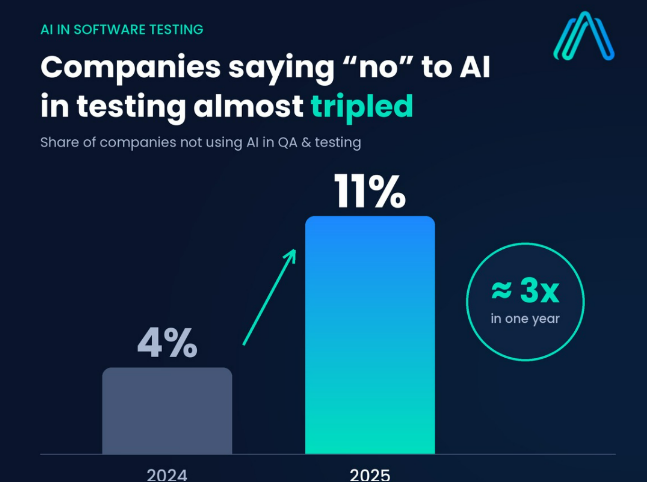
The most important signal is the number of companies that do not use AI in testing at all. This group grew from 4% in 2024 to 11% in 2025, almost three times larger. This does not mean companies are rejecting AI. It means that early pilots showed the real costs, risks and unclear returns, and some companies decided to stop and rethink their approach.
Where AI is in use, the results are positive but modest. Companies report an average productivity gain of 19%, while about one in three sees little or no benefit. Most companies still measure AI by the time it saves, not by the quality it improves, such as finding more defects.
The Katalon study shows the same pattern. Most QA professionals already use AI tools, but only a small minority of teams have reached a truly advanced level of testing.
Where AI is already adding value
AI is moving to earlier stages of the software lifecycle. In 2024, companies mainly used it to write test reports and analyze defects. In 2025, the most common uses are designing test cases, improving requirements and “self-healing” tests that repair themselves when an application changes.
Test automation, however, is still behind. On average, only about a third of test cases are automated, and very few companies have a complete, company-wide automation strategy. AI now writes part of the automation scripts, but it is rarely fully connected to the delivery process.
Test data follows the same story. Almost every company uses AI to create test data, but only a small number have made it a standard part of their daily work.
Five main challenges that stop companies from scaling
In 2024, the main question was “How do we start with AI?” In 2025, it is “How do we use AI safely and at scale?”
1. Connecting AI to existing systems
This is the most common challenge, reported by 64% of companies. Traditional testing tools and delivery pipelines expect the same result every time. AI results can vary, so they do not fit easily into these systems. This is why many projects stay in the pilot stage.
2. Protecting sensitive data
Data privacy and security is the top risk, named by 67% of companies. AI works best with rich, detailed data, but test data often contains customer information that cannot be shared with AI tools. More companies are now using synthetic (artificial) test data, but the tools and ownership for it are still not mature.
3. Trusting the results
Many companies worry that AI can produce answers that look correct but are wrong, and that AI-generated tests may miss serious defects. Developers feel the same: in the Stack Overflow survey, more developers distrust the accuracy of AI tools than trust it. The team remains responsible for every test, whether a person or AI created it.
4. Unclear rules and ownership
More than half of companies are not sure how to meet legal and industry requirements when using AI. Many also lack clear policies for how AI should be used and monitored. Without a clear owner, AI becomes everyone’s task and no one’s responsibility.
5. Lack of skills
Only about half of companies have trained their testers in AI or created AI-specific roles. Because teams lack AI experience, some companies limit access to AI tools, which slows down learning when it is needed most.
The new role of the quality engineer
None of the studies expects AI to replace quality engineers. Instead, the role is changing: from running tests to guiding, checking and controlling the tests that AI creates. The World Quality Report calls this the “expert in the loop”.
This change also brings concern. Katalon found that testers who use AI tools are twice as likely to fear losing their jobs. At the same time, 82% of QA professionals believe AI skills will be critical for their careers in the next three to five years. The most successful professionals combine manual testing, automation and AI skills with strong critical thinking.
In this model, AI handles speed and repetitive work, while people bring judgment, business knowledge and ethical responsibility. The Stack Overflow survey supports this: when developers do not trust an AI answer, most still ask a colleague for help.
Opinions on fully autonomous AI agents are divided. A small group of companies already treats them as a priority, but most are waiting for clear proof before they invest.
What the top 15% do differently
The companies that scaled AI did not simply buy more tools. They changed how they work. Five practices stand out:
Link AI to business results. Measure fewer defects, faster releases and fewer production incidents, not only time saved.
Give AI a clear owner. Create dedicated roles with responsibility, budget and decision power, supported by clear rules for use and monitoring.
Train people to check AI, not only to use it. Teams must be able to question AI results, and companies should test this skill before and after training.
Write clear instructions for AI. Precise and complete requests lead to better results and less rework.
Build a strong data foundation. Give test data a clear owner, use safe synthetic data and connect AI to internal knowledge such as past defects and test patterns.
Conclusion
AI in quality engineering has moved from promise to proof. The 2025 research shows an industry that is moving past the early excitement and focusing on the harder work of using AI in a disciplined way.
Success will not come from having more AI tools. It will come from combining AI with clear rules, good data and skilled people who stay responsible for the results. For QE leaders, the question is no longer whether to use AI, but how fast they can build the right foundations to scale it.
Sources
World Quality Report 2025-26, 17th edition, by Capgemini, Sogeti and OpenText
State of Software Quality Report 2025, Katalon
Katalon press release on the 2025 report
2025 Developer Survey: AI section, Stack Overflow